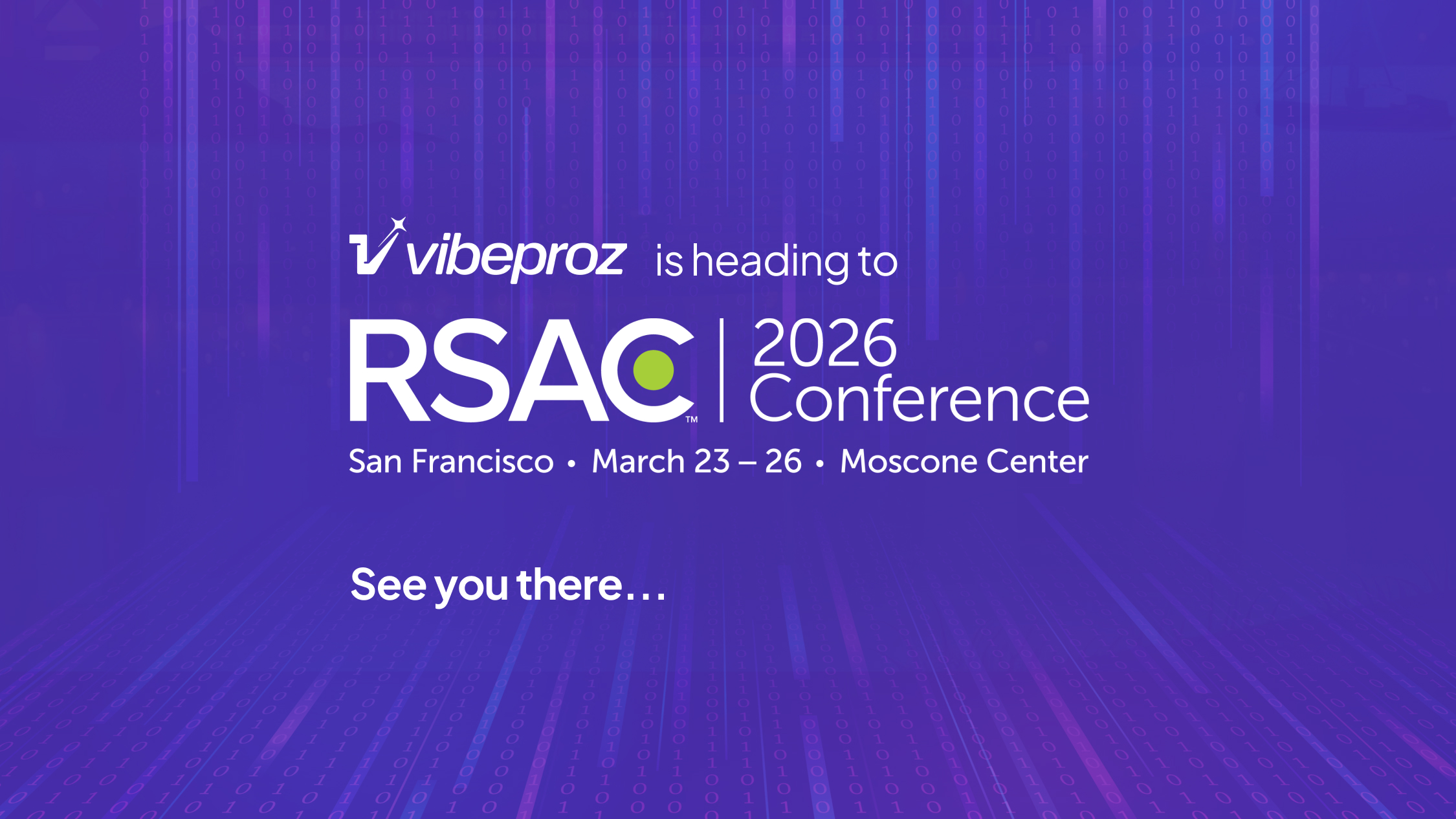
RSA Conference 2026 runs March 23–26 at the Moscone Center in San Francisco — one of the largest cyber security events on the calendar. The RSAC 2026 agenda covers everything from zero trust architecture to AI-powered threat detection. But one conversation is still not getting enough space: what happens to the enormous volume of vibe coded software being shipped right now without the engineering rigour to back it up.
That is the conversation VibeProz wants to have – Vibe coding security at RSAC 2026.
The part of vibe coding nobody wants to deal with
If you have used Cursor, Bolt, or Copilot to go from idea to working prototype in a day, you already know this. The problem is not the speed. The problem is what comes after.
Vibe coded apps are built to show, not to ship. The architecture that gets you to a demo does not get you to ten thousand users. The code that passes your own testing does not always survive contact with real users, real data, or a basic security audit.
We have written about the technical debt problem and where vibe coding breaks down in depth — those posts are worth a read if you want the full picture. What this post is about is what the engineering response looks like, and why RSA San Francisco is a good place to talk about it.
Vibe coding security is its own problem — not a subset of general application security
This is the point that gets missed most often. Vibe coding security at RSAC 2026 is showing up as one of the emerging RSAC 2026 cybersecurity trends precisely because the vulnerability profile of AI-generated code is genuinely different from traditionally written code.
AI code generation tools do not do security. They produce plausible code based on patterns — and those patterns include insecure dependencies, unsafe default configurations, and logic that holds up in testing and quietly fails in production.
The compliance side is often worse. Open-source licensing requirements, data protection obligations, AI-specific regulatory exposure — these are not things vibe coding tools flag. By the time a legal or compliance team catches it, the code is already running in production.
Shadow AI is already a production problem, not a future risk
When developers use external AI tools without governance controls, sensitive business logic and customer data end up in systems outside the organisation’s control. This is not hypothetical. It is happening right now in most organisations of any real size, and most of them have no visibility into it.
Fixing it requires infrastructure-level controls — policy enforcement at the point where developers interact with AI tools. An acceptable use policy sitting in a wiki does not count.
The periodic security audit model does not work here
Ship fast, audit later does not hold for AI-generated codebases. The code changes too quickly. By the time a review happens, the version it was reviewing has been through three more iterations.
Security needs to be embedded in CI/CD and running continuously — not a gate you open right before launch and close immediately after.
Human-in-the-loop is not a buzzword here
There is a lot of HITL talk in AI right now and most of it means very little in practice.
At VibeProz, human-in-the-loop is not a feature or a slide in a deck. It is how the work gets done. Every piece of AI-generated code that comes through us gets human eyes on it before it moves forward — not because we distrust AI tools, but because AI tools are not accountable for what ships. People are.
What HITL looks like
Human review happens before anything progresses, not at the end. Architecture gets assessed not just for whether it works today, but for whether it holds up at scale and under adversarial conditions. Security gets reviewed beyond what automated scanners catch — because AI-generated code has a specific vulnerability profile that most standard tools were not built for.
QA is built around how vibe coded apps actually evolve — fast, non-linearly, with regressions appearing in places nobody expected. A standard test suite applied to a fast-moving AI-generated codebase will miss things. That is not a maybe. It is a pattern we see consistently.
The teams that skip proper human oversight are usually the ones rebuilding from scratch six months later. Not always. But often enough.
DevSecOps for AI-generated applications
Most vibe coded projects are held together by deployment infrastructure that was set up in a hurry. It works until it does not — and when it breaks, it is hard to diagnose because observability was never part of the original setup.
DevSecOps for AI-generated applications is not standard DevOps applied to AI-generated code. The pipelines need to account for how this code actually behaves — the rate of change, the specific vulnerability classes it introduces, and the compliance requirements that attach as the product scales.
One of the more underrated RSAC 2026 security innovations is how DevSecOps tooling is beginning to catch up to AI-generated development workflows. The gap between the two is closing, but most teams are still operating right in the middle of it.
Smart QA for AI-built products
Standard QA assumes a codebase that changes in predictable ways. Vibe coded apps do not. An iteration that fixes one thing breaks another, and the test suite from last week may not cover what the code looks like today.
Smart QA for AI-built products means automated test coverage built specifically for AI-generated codebases, continuous integration that catches regressions at every iteration, and human-led exploratory testing for the edge cases that automation consistently misses.
For anyone deploying into a regulated environment — healthcare, fintech, anything with real compliance exposure — this is not something you can skip and sort out later.
Who should find time to talk to us at RSAC 2026
If any of the following sounds like your current situation, it is worth carving out 30 minutes from your RSAC 2026 schedule in San Francisco.
Founders who vibe coded their MVP and are now looking at production
The demo works. Production is where the questions start — architecture that does not scale, a codebase harder to maintain than expected, security that has never been properly reviewed. This is exactly the situation VibeProz was built for.
Enterprise teams running internal AI-generated development
The productivity gains are real. The governance is usually not there yet. Shadow AI exposure, code quality inconsistency, and no clear path from prototype to something the engineering organisation actually wants to own — these are the problems showing up consistently. Attending RSAC is a good forcing function to think seriously about what the internal framework should look like.
Technical leaders carrying the security brief for AI-built products
The vulnerability profile of AI-generated code is different from what standard security tooling was built to catch. If you are accountable for the security posture of software built at least in part by AI tools, the conversation with VibeProz is worth having.
Meet VibeProz at RSA Conference 2026
RSAC 2026 is at the Moscone Center, San Francisco, March 23–26. The VibeProz team will be there for RSA week. The RSAC 2026 exhibitors list covers most of the established security vendors — we are there for the conversations that happen outside that footprint, with the builders and technical leaders who are working through vibe coding security problems in real time.
The conversations we are looking for are practical ones — what does it actually take to get vibe coded software to production safely, and how do you secure and scale it once it is there.
If that is a problem you are sitting with right now, it is worth finding time.
Meetings are available in person at the RSAC 2026 venue and virtually before or after the event.